

Good Afternoon,
Welcome back from the summer break. In August, 2026 I noticed it’s the end or an era or the start of a new one. I call it the age of “Sovereign Quantum”, where traditional allies of the United States will be pressured to build up their own emerging tech base as part of their National Defense budgets and increasingly to protect their own Sovereignty. Full disclosure, I am Canadian.
I did not see this coming! This will from now on shape the future of Quantum technologies. Countries like Canada, Australia and smaller European countries have a lot of talent in this domain and a lot of Quantum startups for their population size and GDP.
I just spent half a week diving into one of the European leaders in Sovereign Quantum. A company that recently went public. You can read it here (that is a very deep dive on a single company for investors):
Today I want to share a brief note on Xanadu over in Canada.
I’m Canadian and I’d now consider Xanadu a Sovereign Canadian Quantum leader. Let me go into a bit of why that is. It turns out the former Campbell’s Soup facility will become the manufacturing site for Xanadu Quantum Technologies. Xanadu’s stock has been suffering XNDU 0.00%↑, as many to most Non-US equities have tended to in recent years on the U.S. markets.
They went public on March 27th, 2026. Dual listing on the NASDAQ and Toronto Stock Exchange (TSX). But they have not ridden the Quantum “meme stock” craze we’ve seen in recent years. Most retail investors don’t know who Xanadu are and a fair bit of the Quantum community don’t even realize they are public yet.
With trade tensions and threats between the U.S. and Canada, it’s a very different environment between the U.S. and allies like those in Europe, Canada and elsewhere and this is spilling into how those regions see their National Defense investments. Quantum of course has National security implications in cybersecurity but also in terms of impacts on Space-technologies and due to impacts like Quantum sensing and communications in military surveillance.
More National Defense investments also mean more potential Government funding for emerging technologies like Space, Quantum, Satellite makers and AI startups.
Huge Canadian Investment in Xanadu
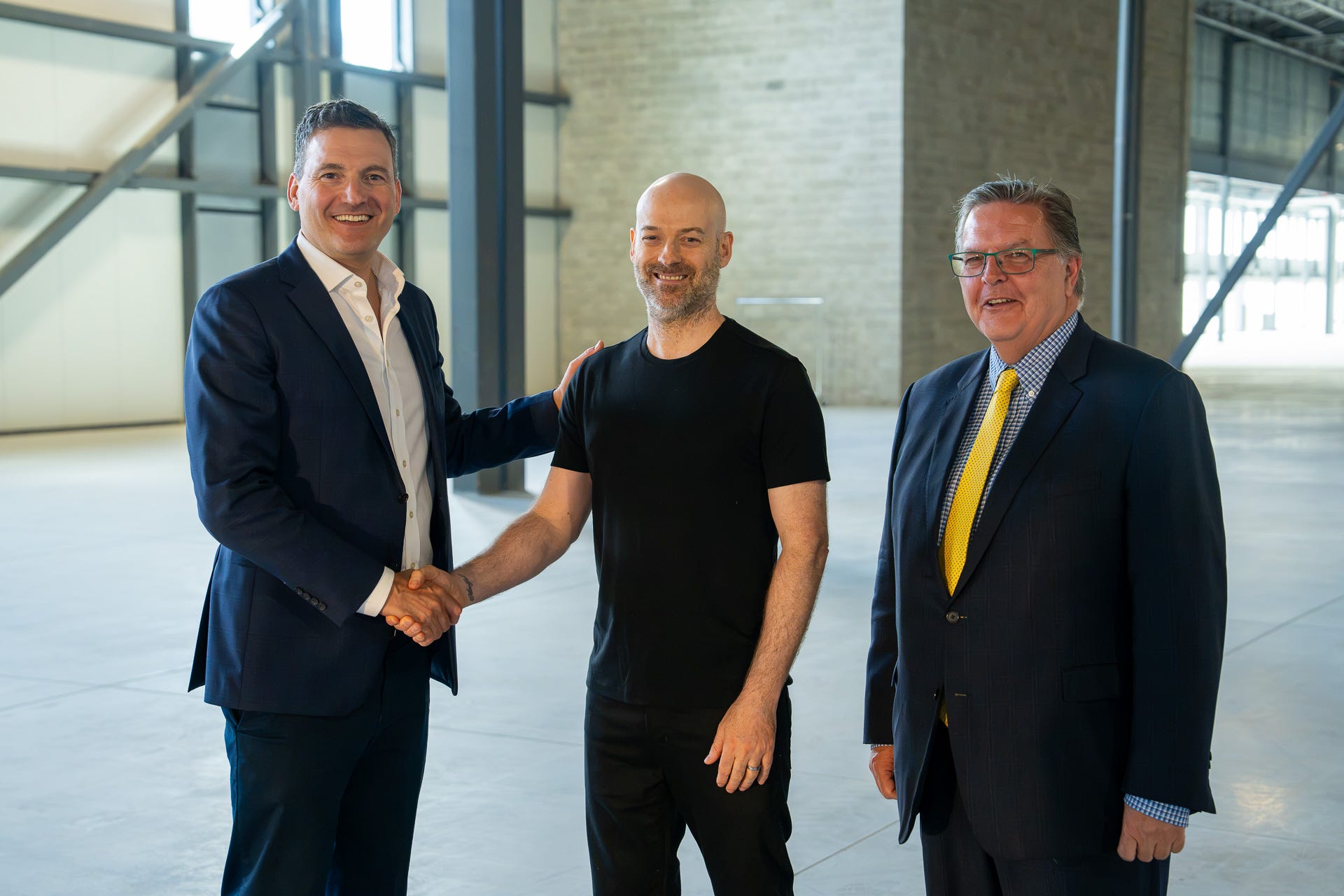
On August 28th, 2026 the Canadian Government invested in Xanadu with a huge grant (loan). This is the date I set as the official start of the “Sovereign Quantum” era for Non-U.S. western based countries and nations.
Against the backdrop of the Canada-U.S. trade war, and U.S. President Donald Trump's frequent threats to Canada's sovereignty, Evan Solomon (the so-called Canadian minister of AI and innovation) leaned heavily into patriotism as he announced $195 million in repayable federal funding for Toronto-based Xanadu Quantum Technologies.
Founded in 2016, Xanadu builds software and quantum computers powered by light. The $195 million package is structured as repayable funding (a government loan) rather than an equity acquisition. Unlike a traditional bank loan, it carries flexible terms with no fixed repayment date.
Pasqal over in France had already gotten a lot of funding and grants from the French Government. Now other countries outside of China and the U.S. will have to boost their top Quantum startups to develop their own capabilities. All of the U.S. pressure have pushed Canada closer with the EU and especially Germany in National Defense and space-tech matters.
On the NASDAQ, Xanadu has been penalized even further than most non-U.S. Quantum companies now with a market cap of just $507 million dollars. Xanadu is extremely unprofitable and barely making any money. In their most recent earnings they made just $1.5 million (down from $2.8 million in Q1 2026, but up 36.4% year-over-year from $1.1 million in Q2 2025, primarily driven by DARPA Stage B project funding).
Project OPTIMISM
This is how Xanadu described the grant from Canada.
“The CAD $195 million federal commitment formalizes the complete federal portion of the potential funding of up to CAD $390 million in support announced on March 11, 2026 for Project OPTIMISM.”
Xanadu went public by combining with Crane Harbor Acquisition Corp. (a special-purpose acquisition company). A SPAC, more or less the least credible, but fastest, way to go public.
The SPAC deal implied a pre-money equity value of $3.0 billion USD for Xanadu. Founder and CEO Christian Weedbrook holds over 46 million high-vote shares, granting him ~17.9% of total voting power directly essentially way more insider ownership than is normal for such a situation.
Xanadu is a Canadian photonic quantum computing company with the mission to build quantum computers that are “useful and available to people everywhere.” Xanadu is building fault-tolerant quantum computers using light, with systems designed to compute at room temperature. Xanadu develops both hardware and software, including PennyLane, its open-source quantum computing platform.
A lot does not add up here.
In 2023, the Canadian federal government launched its $360-million National Quantum Strategy. Friday's $195-million repayable financing pledge to Xanadu represents its largest single financial commitment to manufacturing quantum technology.
Xanadu’s Product Road Map Isn’t Likely Very Realistic
I very used to Canadian Quantum startups that are essentially like vaporware. While I don’t consider Xanadu part of that group, I am concerned.
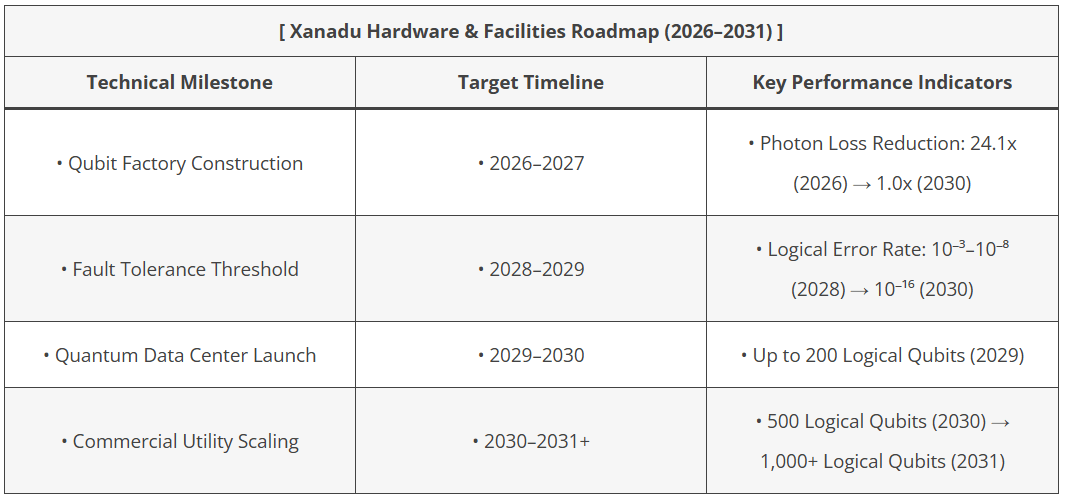
So two days ago, Xanadu releases its product roadmap of 2026 promising over 1,000 logical qubits by 2031, or five years from now. It’s a slide deck format worth looking at:
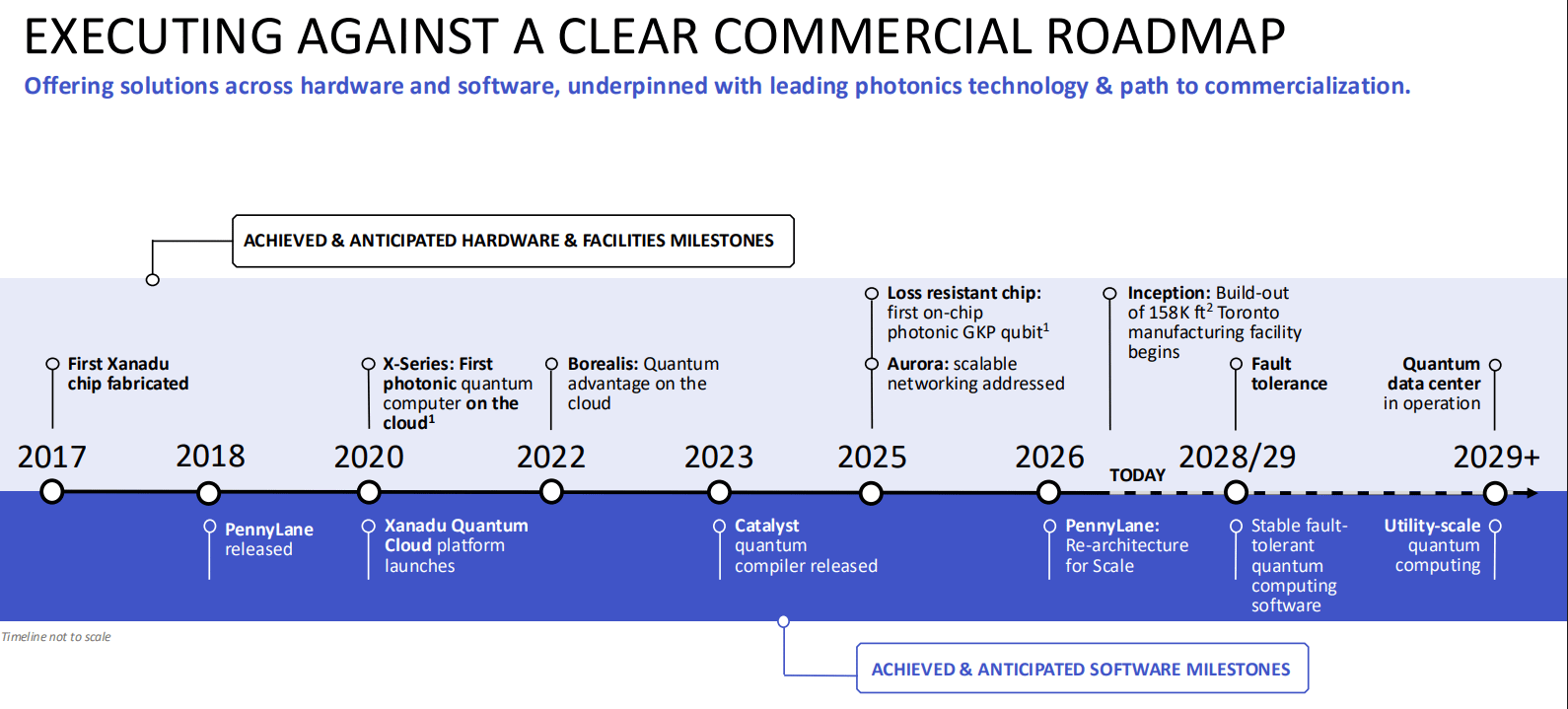
There’s not much commercial evidence (ten years after being founded) that Xanadu is on the right track.
Am I supposed to take these plans at face value?
