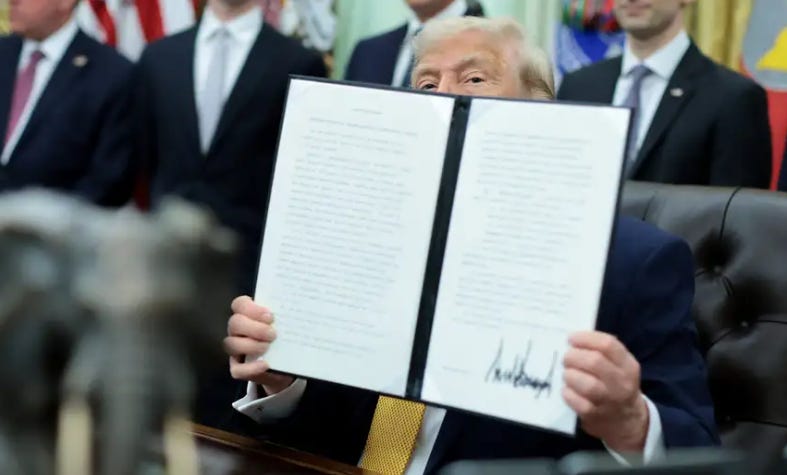
What do Trump's Quantum Executive Orders even mean?
Are there behind the scenes deals going on? Nothing is what it seems with this Administration.
I am supposed to be on a summer break, thinking less about emerging tech, geopolitics or the connections between Quantum and Space. This week President Donald Trump ordered a push on Monday to build a powerful quantum computer for scientific research and speed efforts to protect government systems from related cyber threats. I have mixed feelings about the U.S. Government taking stakes in Quantum computing companies.
US President Donald Trump signed two executive orders.
Read the Fact Sheet.
Quantum companies heralded the move as important Executive Orders that reflect the growing strategic importance of quantum technologies to U.S. economic competitiveness, scientific leadership, and national security. It was certainly good for Quantinuum’s stock price. QNT 0.00%↑, now up 27.5% since the recent IPO.
I can’t help but feel something is not quite right here. Here the POTUS is basically tasking the departments of Energy and Defense with building and hosting a quantum computer for scientific research. Perhaps his family owns some Quantum computing stocks.
The “Ushering in the Next Frontier of Quantum Innovation” order, signed by U.S. President Donald Trump June 22, gives NASA 120 days to submit a five-year plan for “developing and extending civilian quantum sensing and networking for space applications.”
Other agencies were also tasked with producing five-year plans to translate atomic-scale physics into federally backed research and applications.
The order directs the “Department of War” (the DoD) to identify at least three next-generation quantum sensor projects within 60 days to prioritize for fielding by Sept. 30, 2028.
It also establishes the Quantum Computer for Application Development and Discovery Science effort, or QC-ADDS, to develop a quantum computer for scientific applications.
Again it seems the U.S. is paranoid of losing their lead to China. This order aims to boost American leadership in quantum technologies amid competition (e.g., with China).
It aims to switch all government computing to post-quantum cryptography by 2031. When in fact the danger likely arrives in 2028 or at the latest in 2029. Quite baffling. President Trump recognizes that quantum technologies are on the verge of a massive commercial breakthrough, according to the announcements and require a bold new policy approach to ensure America continues to lead the field. But nobody outside of IonQ (and to a very limited degree) is generating any meaningful scalable revenue thus far in the Quantum companies that are public.
As you might know, in January 2025, President Trump announced the establishment of the President’s Council of Advisors on Science and Technology to spearhead American innovation and competitiveness in critical and emerging technologies.
Under EO 14411, the Department of Energy (DOE) must lay out the technical specs for the multi-agency science-grade quantum computer by 2028. Companies that might have relevance here include:
IBM: Explicitly named as a primary beneficiary of the administration’s market commitments. IBM’s current commercial roadmap targets a fault-tolerant system by 2029, meaning the administration’s aggressive 2028 target heavily leverages IBM’s existing data center-integrated quantum processors.
Microsoft: Heavily involved due to its recent breakthrough developments with the Majorana 2 topological qubit, which drastically reduces quantum error rates. Microsoft’s Azure Quantum infrastructure will be heavily leaned on for the software and classical-quantum hybrid orchestration layers.
Google: A key player because of its stated goal to transition its own systems to post-quantum cryptography by 2029 and its extensive quantum hardware labs.
In addition to a wide range of Quantum computing startups. Namely the likes of SandboxAQ, Infleqtion and others more related to National Defense. There are other more impactful Quantum computing startups that are public like Quantum, and not public yet. But the group is relatively small. The Quantum intersection with Space-Technology however is real, especially in Quantum sensing and communications.
The administration is using its $2 billion commitment to guarantee market demand for the hardware makers, while using the FAR contractor rules to force the entire U.S. enterprise tech supply chain to fund its own transition to quantum resistance. The Department of Commerce involved in funding Quantum companies announced earlier this year is far more concerning and unusual. Where:
GlobalFoundries will receive $375 million in planned funding to establish a secure, domestic quantum foundry for leading architectures and multiple modalities (superconducting, trapped ion, photonic, topological, and silicon spin) used in large-scale quantum computers.
IBM will receive $1 billion in planned funding to establish a new quantum foundry subsidiary for quantum-grade superconducting wafers by building on its U.S. leadership in superconducting quantum wafer fabrication technology.
Atom Computing will receive $100 million in planned funding to address key technical and manufacturing challenges for neutral-atom quantum computing, including hardware development and systems integration needed to manipulate, control, and address tens of thousands of qubits, and validate their performance.
Diraq will receive up to $38 million in planned funding to develop and scale quantum logic units and accelerate critical manufacturing and integration capabilities for silicon spin quantum computing technologies, including novel designs for large-scale and reliable qubit arrays.
D-Wave will receive $100 million in planned funding for critical advancements in annealing and gate-model superconducting quantum computing systems, including qubit counts, error rates, and coherence through advanced dielectric material optimization, interface control, and high-density advanced packaging.
Infleqtion will receive $100 million in planned funding to develop the underlying engineering systems and integration requirements for large-scale neutral-atom-based quantum computers and architectures, including high-powered optical systems, novel readout and error correction systems.
PsiQuantum will receive $100 million in planned funding to address key photonic quantum computing technical challenges for matured and high-performance electro-optic materials, high-temperature single-photon detectors, and ultra-low-loss photonic packaging.
Quantinuum will receive $100 million in planned funding to address critical technology and manufacturing bottlenecks for scaling of fault-tolerant trapped-ion-based quantum computers, such as low-loss integrated photonics, and reliable optical components at trapped-ion critical wavelengths.
Rigetti will receive up to $100 million in planned funding to address key technical challenges to develop and scale next generation superconducting quantum computing technologies and architectures, such as miniaturizing and integrating novel readout electronics and next generation cryostat architectures.
The US government is taking equity stakes in quantum computing companies. The State should never be involved in the marketplace like this, because it develops conflicts of interest and political corruption. The former CEO of Google comes to mind in his work with both the Government, National Defense planning and being involved in SandboxAQ and now in a Space rocket company that mysteriously won a Mars contract. How does any of that make sense? Trump collaboration with angel investors and VCs is just really poor judgement in this administration because they have financial incentives involved. That’s not what a competent or lawful U.S. Administration would do. Let’s be clear about that.
So we have to take all of this news with a grain of salt. You cannot tell what deals are involved with the POTUS and how much this actually involves legit National Defense or Quantum leadership. Nor are the above companies equally deserving of this kind of funding or equity stakes in them.
This gives the Trump Administration his connection in the industry the ability to help pick the winners in Quantum with favorable contracts with the Pentagon and Space-technology budget. Why would NASA hire Relatively Space, easily at best the 5th best rocket maker in America? Relativity Space — a rocket maker acquired by former Google executive chair Eric Schmidt last year after stumbling on the path to orbit — might just beat SpaceX to Mars. On Tuesday, NASA said it hired the company to build a spacecraft to house a suite of scientific instruments, launch it into space, and fly it to Mars. How? Why? There are a few more deserve rocket companies than this obscure rocket startup. This is highly irregular.
The structure of the contract is akin to the deals that NASA made with SpaceX to fly cargo to the International Space Station, or Firefly Aerospace to put a lander on the moon. The government agency handles the science, while the private company provides low-cost infrastructure.
Rocket Labs, FireFly, Blue Origin or SpaceX itself would have been more logical choices. Relativity Space have yet to launch, well anything. Sort of like the dead on arrival group of Quantum computing companies above (outside of Quatinuum).
The partnership between NASA and Relativity Space for the 2028 Aeolus Mars mission surprised a lot of people in the industry—especially since Relativity’s new heavy-lift rocket, Terran R, has yet to fly and the company has zero orbital successes under its belt.
It’s clear the U.S. Government has its favorites and they are usually tied to a Billionaire or a Tycoon, these days. This is what Washington has come to these days. All of which isn’t meritocratic and means the U.S. might actually struggle compared to China in the two decades ahead. The best teams won’t always be getting the right Government contracts, which I see happening with Anduril already as well. The Deep state has been compromised by the Billionaire class. Trump is likely little more than a firebrand puppet. Thankfully Trump won’t be in office when Quantum computing really gets going more likely in the 2029 to 2035 window.
Science and frontier technologies should not be meddled by politics and lobbying of special interest groups. Especially not Venture Capitalists, who I have found are often not the brightest at long-term strategy that Nations most require for their collective self-interest. To put it mildly, this administration’s approach to science funding is characterized by a "re-prioritization" strategy that is causing significant friction within the research community.
The EO calls for the Pentagon to deploy quantum-enabled sensors by 2027. The executive orders came shortly after U.S.-based quantum technology firm Infleqtion announced America’s Quantum Space Initiative, an industry coalition aiming to advance demonstrations to operational capability. Infleqtion INFQ 0.00%↑ barely makes any commercial revenue.
As for America’s Quantum Space Initiative: Founding partners include Voyager Technologies, VOYG 0.00%↑ , Armada, Monarch Quantum and the University of Colorado Boulder.
In the U.S. now if you want to know who the winners are going to be in any particular field, you just have to see who the Billionaires are that back them. Especially when it comes to those lucrative contracts from the Pentagon, NASA or anything like that. Or who gets the U.S. Government to have equity in them.
The U.S. government took an unprecedented 9.9% equity stake in Intel in August 2025, investing $8.9 billion to acquire roughly 433 million shares at an average price of $20.47 per share.
With Intel’s stock trading at $131.90 (as of June 2026), the stock is up a whopping roughly 544% since that government investment. That’s fairly mysterious, given that Intel is now getting all of these surprise new contracts that are fairly significant. Not a coincidence! This POTUS is meddling in America’s future and his associates and family stand to financially benefit from it. This is not the capitalism or marketplace we once knew in America.
Last time I checked Eric Schmidt is no Jeff Bezos and Intel is no TSMC. American Quantum companies are not making significant progress outside of just a few. Most of those are not even public companies yet. In June 2026, the U.S. Department of Commerce signed a definitive agreement awarding SandboxAQ $500 million under the CHIPS and Science Act. Rather than structuring this as a traditional, hands-off federal grant, the government pivoted to a venture-capital model. The company's origins trace back to 2016 when Hidary launched a quantum technology and AI group within Alphabet Inc. Guess who? Former Google CEO Eric Schmidt was the first outside investor and currently serves as Chairman of the Board.
If this is the how the trail-blazing United States innovation machine works now, you have to wonder what is in store for us moving forwards. You can get on the horses now based on how wealthy they are and how much influence they have over the current President and his advisors and administration. That’s not the definition of a country that’s thriving or even an empire that’s healthy. Certainly not how science and the marketplace are supposed to work.
The PR announcements about the Executive Orders are all positive though. “Quantum is moving fast, and so is the competition,” said Matt Kinsella, Infleqtion’s CEO. But Quantum in America hasn’t been moving fast, and Infleqution itself may not have a going future in just a few years time. If anything, America’s lead in Quantum since the two Trump Administrations has lagged how far it was ahead of China before. China is catching up in Space, AI and Quantum, and no Executive Orders tell much of that story.
The order directs federal agencies to update the National Quantum Strategy, support the development of a federally backed quantum computer for scientific applications, expand work on quantum sensors and networks, strengthen domestic supply chains and build a larger quantum workforce. But can I believe this is being done in a responsible or meritocratic fashion? I cannot in good conscience believe that.
This has to be more than complementing an incompetent and corrupt President. This has to be about putting America’s interests first. The U.S. in will in the years ahead build a Sovereign Wealth Fund and Trump will benefit himself and his family financially at every possible turn. Knowing this makes all of these Executive Orders feel hollow and somewhat peculiar.
click here to download the PDF version of the NIST press release.
The Aeolus (Mars) mission is actually being paid for by an unnamed philanthropic backer connected to Schmidt's network. This allowed NASA to structure a cost-effective, six-year reimbursable Space Act Agreement. Who do you suppose that is? Quantum, Space and National Defense priorities are blurring and America’s financial elite and their VC interests are taking over what should be Government affairs.
I will note that Billionaire entrepreneur and private astronaut Jared Isaacman is now suddenly the head of NASA. As you can expect many planetary scientists, academics, and long-time NASA personnel are alarmed by Isaacman's radical policy pivots and business connections taking priority.
Energy Secretary Chris Wright described quantum computing as the third pillar that will join artificial intelligence and high-performance computing powered by advanced semiconductors as the foundation for future computing technology. We will see, we will see about all of this.


