


This week two separate Quantum stories really struck me and grabbed my focus. Can open-source LLMs spur Quantum forward? That’s what Nvidia is betting on with their Ising product.
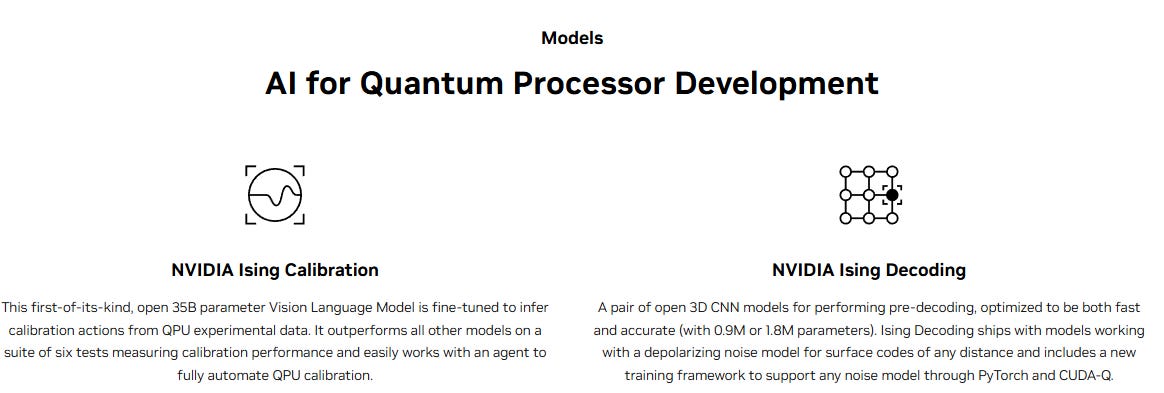
Nvidia says this “open-source family of AI models” spans key quantum workloads, starting with Ising Calibration for automating the rapid tuning of quantum processors and Ising Decoding, which accelerates the real-time decoding required for quantum error correction.
On April 14, 2026 (World Quantum Day), NVIDIA officially launched Ising. Nvidia is betting that “AI is key for turning today’s quantum processors into large-scale, reliable computers.” We don’t know if this is actually true, but it’s an interesting concept. Nvidia is saying that their models empower developers to build high-performance AI while maintaining total control over their data and infrastructure.
We do know that Nvidia has built quite a lot of partners around Quantum and have invested in a lot of Open-source AI startups and are keen to build their own. Meanwhile, IonQ, ticker IONQ 0.00%↑, literally the only half-way successful Quantum stock has been chosen by an important program by DARPA called HARQ.
IonQ was selected for DARPA’s HARQ program to develop architectures for networked quantum computers across multiple qubit types.
Both of these news items could be a big deal in Quantum coming out of its winter period. Totally ridiculous of course that IonQ is worthy nearly $16 Bn. on the public markets. IonQ barely makes any revenue to justify such a valuation. IonQ reported just $130 million in GAAP revenue for full-year 2025 (ended Dec 31, 2025), representing 202% year-over-year growth from $43 million in 2024. I’m not sure it has a going future, but DARPA idea to combine qubit types is the new fad. We have talked about this with regards to Google Quantum’s own dual-qubit strategy previously.
The HARQ program focuses on integrating trapped ions, neutral atoms, and superconducting qubits using photonic interconnects to improve scalability and performance. A unified qubit system that takes the benefits of each system together makes a lot of intuitive sense. Some systems scale better, while others are more stable.
I’ve been saying for a while that I thought LLMs could help leverage better Quantum computers and that Quantum computing and LLMs could eventually converge in ways that aren’t obvious yet.
Have a multi-qubit system and using AI to leverage Quantum actually should work together. Hopefully well funded Quantum companies like Quantinuum and SandboxAQ have their eyes on this, as well as the likes of Microsoft, IBM and others. Nvidia is putting it on thick:
